Sustainable aviation fuel
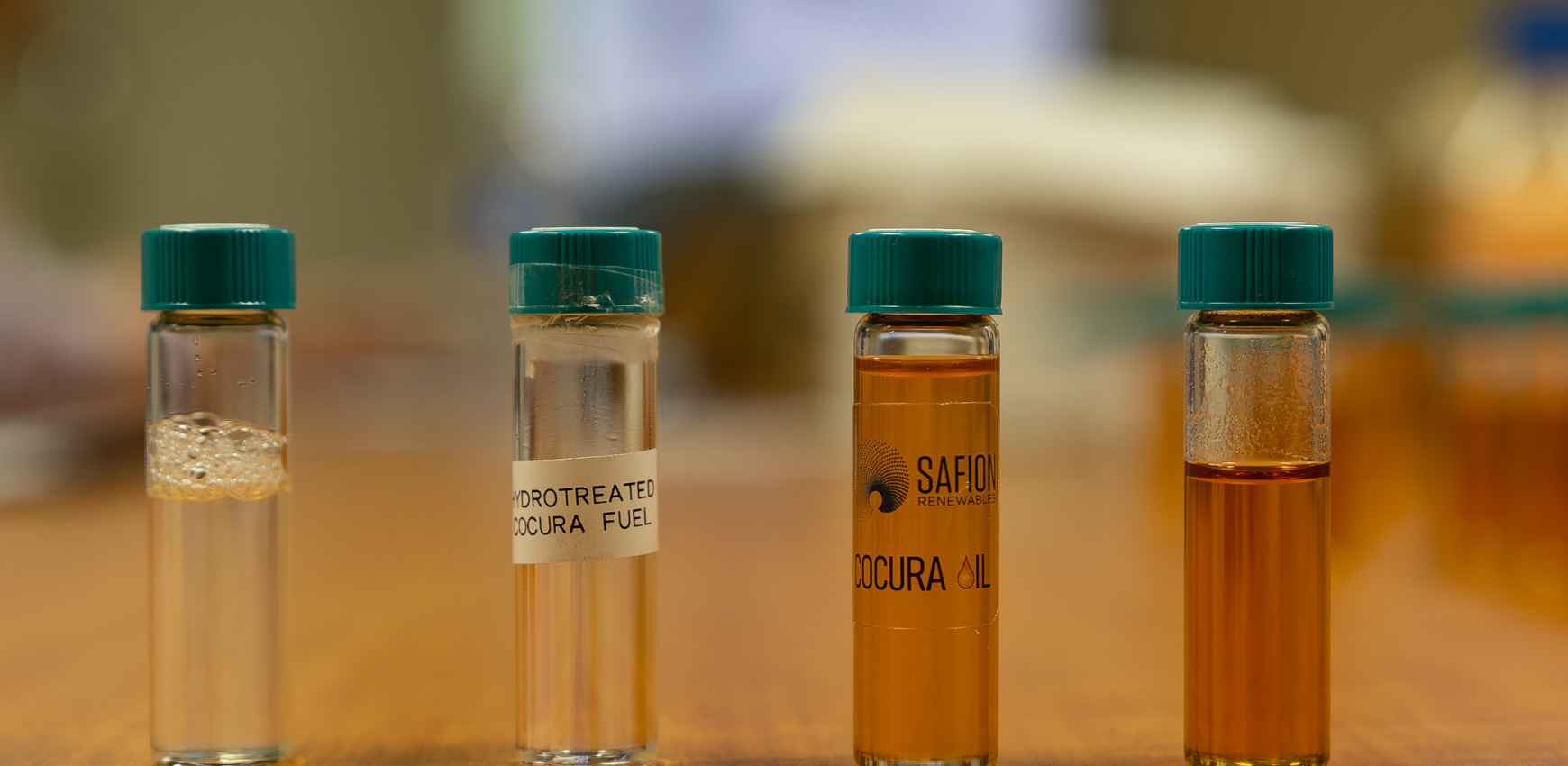
Hydrotreatable lipid feedstock designed to enter existing HEFA and refinery infrastructure.


Cocura Oil™ platform
Cocura Oil™ is an extracellular oil platform built to bypass the recovery, sterility, and scale-up bottlenecks that have held back fermentation-derived oils.
Extracellular platform oil · demonstrated through 10,000 L
The industry problem
Hydrotreating is already a proven route to aviation fuel, but the supply of affordable, sustainable lipid feedstocks is constrained. Expensive processing steps keep many fermentation pathways from competing with existing lipid sources.
The industry does not need another molecule that can be made. It needs an oil that can be made, recovered and scaled economically.
The Cocura Oil™ answer
Cocura Oil™ is secreted directly into the broth by Safion’s proprietary engineered host, placing the product where it can be recovered simply and economically: outside the cell and in a separate dense oil phase.
The product does not need to be liberated from biomass. That removes the most punishing unit operations from conventional microbial-oil recovery.
The organism acidifies its own broth, suppressing common contaminants and reducing sterility burden.
Safion improves an endogenous pathway rather than asking the host to carry a heavily foreign metabolic program.
The same short-chain, hydroxylated lipid supports fuel, lubricant, flavor, surfactant and antimicrobial value chains.
Evidence, not aspiration
Safion has repeatedly scaled the fermentation and primary recovery process, producing metric-ton quantities and validating the same simple separation logic at manufacturing-relevant scale.


One oil. Multiple markets.
A broad SAF outlet can absorb the majority of production, while smaller-volume, higher-value products strengthen plant economics and reduce reliance on a single market.
Hydrotreatable lipid feedstock designed to enter existing HEFA and refinery infrastructure.
Hydroxylated short-chain lipids and derivatives for friction modification and specialty lubrication.
A low-CI natural flavor and fragrance ingredient positioned as an alternative to bark-derived massoia supply chains.
Amphiphilic lipid chemistry for wetting, cleaning, emulsification and specialty formulations.
Intact Cocura Oil chemistry with demonstrated bactericidal potential for selected applications.
Product allocation can follow market demand: preserve a large-volume outlet for hydrotreating while selectively capturing higher-value specialty markets.
Additional products in development include low CI urethanes, 3D printable polymers, composites, and coatings.
Massoia lactone can be isolated as a low-CI natural alternative to conventional bark-derived massoia ingredients, extending the platform into flavor and fragrance markets.
Capital-light commercialization
Safion's commercial model is built around leasing existing idled fermentation capacity, adding a compact Cocura Oil recovery train, and using mature regional hydrotreating infrastructure instead of financing a greenfield complex.
The operating model is designed to push capital toward market proof and site profitability rather than toward new concrete, utilities and stainless steel that already exist.
Representative geographies from Safion development materials illustrate the broader thesis: existing fermentation assets can be reactivated, upgraded with Cocura Oil technology and connected to real market pathways without building a new greenfield complex.

Existing vessels, utilities, controls, labor pools and site infrastructure are reactivated rather than rebuilt.
Proprietary strain, fermentation recipe, controls and compact gravity recovery.
Regional HEFA, hydrotreating, tolling and product distribution infrastructure.
Full-scale partner opportunity
Safion is engaging facility owners, refiners, strategic offtakers and investors to move Cocura Oil™ into its next operating platform.